

Gateless parking systems eliminate mechanical failures and maintenance costs by replacing physical barriers with license plate recognition cameras, mobile payments, and automated enforcement software. Properties switching to gateless solutions report 20-35% revenue increases while cutting operating costs by 20-25%. Modern LPR technology tracks every vehicle entering and exiting, automating payments and enforcement without physical gates that break, jam, or require constant repairs.
• Gate arms fail due to vehicle impacts, weather damage, and mechanical wear in high-traffic environments, creating single points of failure that shut down entire entry/exit lanes
• Broken gates cost facilities through direct repairs, lost transactions during downtime, and staff pulled from other tasks to manage traffic chaos
• Gateless systems use four core technologies: license plate recognition cameras, mobile payment processing, real-time analytics dashboards, and dynamic pricing algorithms
• AirGarage partners see 12-27% revenue increases after enabling automated dynamic pricing that adjusts rates based on demand
• Alternative solutions range from full-service management (AirGarage) to SaaS tools (ParkAlto, T2 Systems) and security-focused platforms (Eagle Eye, Verkada)
• Tower Investments' Parkadelphia garage eliminated gate malfunctions and grew revenue 20% month-over-month after switching to gateless operation
If you own or manage a parking facility, you know the headache. The gate arm snaps off again. A driver backed into it. Someone forced through without paying. Now you have a traffic jam, an angry line of customers, and a repair bill on the way.
These breakdowns are not random bad luck. They are baked into the design of traditional gated systems. Moving parts wear out. Mechanical components fail. And every repair means lost revenue and frustrated parkers.
The good news? A gateless parking system offers a way out. By replacing physical barriers with license plate recognition cameras, mobile payments, and real-time enforcement software, you can eliminate the root cause of most parking headaches. Drivers enter, pay by phone or automatically on exit, and leave without stopping. You get live occupancy and revenue data without the constant maintenance.
This post breaks down why gate arms fail, what that failure actually costs you, and five alternatives worth considering.
Gate arms break for one simple reason: they are mechanical devices in a high-traffic, high-stress environment. Vehicles hit them. Weather wears them down. Motors burn out. Sensors misfire.
Traditional methods like parking gates and attendants create traffic backups, require constant maintenance, and have high overhead costs. Every gate arm is a single point of failure that can shut down an entire entry or exit lane.
The maintenance burden goes beyond the gate itself. Pay machines jam. Ticket dispensers run out of paper. Cash boxes need emptying and reconciling. Each of these touchpoints adds labor, complexity, and risk.
Meanwhile, urban mobility demands are only increasing. Traffic jams, long commutes, noise, and pollution have become major blights on urban life. Parking facilities that create bottlenecks at entry and exit only make things worse.
New technologies offer a different path. Parking managers can now collect large quantities of data at relatively low costs, which results in more transparent decisionmaking, particularly when setting parking rates. A gateless system removes the physical barrier entirely and replaces it with software that tracks every vehicle, automates payments, and enforces compliance remotely.
Key takeaway: Gate arms fail because they are mechanical devices in harsh conditions. Gateless systems eliminate the failure point altogether.
The repair bill is just the beginning. When a gate goes down, you lose revenue in three ways:
Electronic parking meters have essentially replaced mechanical meters, offering improved security and a simplified process for changing parking rates. But if you are still running a gated system, you are paying for two generations of technology at once.
The numbers can be stark. A typical urban parking space has annualized land, construction, and operating costs that total $500 to $1,500. When gates malfunction, you are not just losing a few transactions. You are undermining the economics of the entire facility.
Software-only alternatives come with their own cost structure. ParkAlto consists of a setup fee plus a fixed monthly fee that includes all support, upgrades, and hosting of the system. Predictable costs beat emergency repair bills.
Tower Investments learned this firsthand. Their Parkadelphia garage, an 800-plus space facility in downtown Philadelphia, faced frequent gate malfunctions that led to traffic jams and costly repairs. Cash payments resulted in unreliable revenue tracking. After switching to a gateless, camera-powered system, "revenue grew 20% month over month," according to the Tower Investments case study. Congestion at exits disappeared, and manual oversight was replaced with automated enforcement and clear reporting.
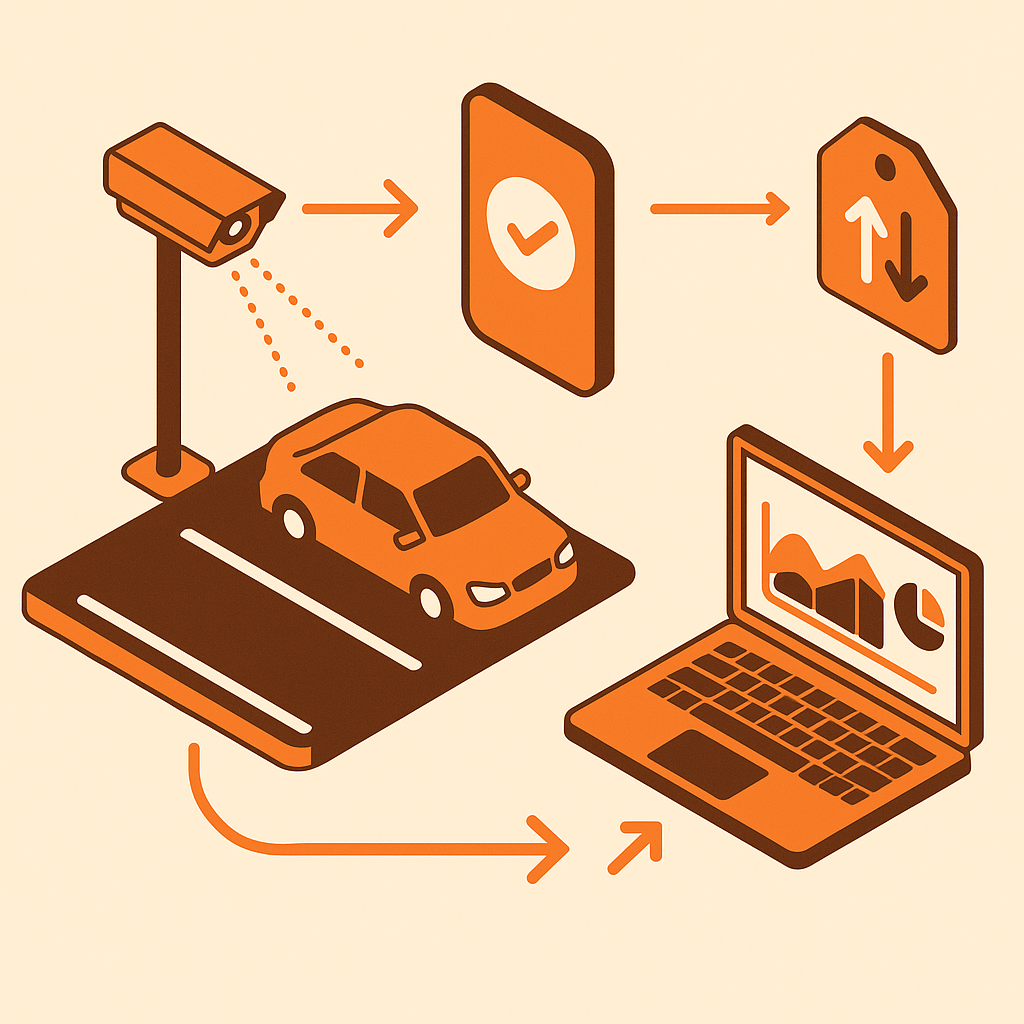
A gateless system relies on four core technologies working together:
Advances in license-plate-recognition technologies and space sensors further improve enforcement and data collection. The combination of these tools means you can run a parking operation without a single moving barrier.
Urban congestion charging mechanisms work thanks to digital cameras that are able to identify license plates and classify vehicles in urban areas. The same technology that manages city traffic can manage your parking facility.
AirGarage's enforcement technology utilizes automated license plate recognition (ALPR) to ensure that only authorized vehicles use your spaces. The platform offers instant access to critical information such as parking occupancy, duration of stays, and turnover rates.
For a deeper look at real-time analytics, see the AirGarage Intelligence Dashboard.
If you want to remove gates and offload day-to-day operations entirely, a full-service partner handles everything: payment collection, enforcement, dynamic pricing, signage, and customer support.
AirGarage operates this way. The company installs LPR cameras, manages all payment processing, and deploys local enforcement teams. Property owners access a dashboard showing real-time revenue, occupancy, and operational metrics.
The results can be significant. At The Showboat Resort, the largest non-casino hotel in New Jersey, broken gates and equipment malfunctions were causing long wait times and revenue leakage. After transitioning to AirGarage's gateless system, "revenue increased 25-35%" and "operating costs dropped by 20-25%" in the first year, according to the Showboat Resort case study.
Dynamic pricing is a major driver of these gains. AirGarage partners have seen their revenue increase 12-27% after enabling the dynamic pricing engine. Rates adjust automatically based on demand, so you capture more revenue during peak periods without manual intervention.
Advances in LPR technologies make this model possible. The technology that once required expensive hardware and dedicated staff now runs on cloud software and commodity cameras.
For parking lots specifically, see AirGarage's parking lot solutions.
If you manage parking for a university, hospital, or municipality, you may need permit management alongside enforcement. T2 Systems serves this niche.
T2 Systems specializes in permit management, enforcement, mobile payment, multi-space and single-space parking meters, and data analytics. The company has been serving customers since 1994 and focuses on integrating and streamlining operations for large institutions.
T2 Permits and Enforcement is a web-based solution fully hosted in a PCI-DSS Level 1 environment. This matters for organizations with strict compliance requirements.
The approach differs from full-service management. T2 provides software tools, but you still run the operation. You handle staffing, customer service, and enforcement decisions. The platform gives you data and automation, but the responsibility stays with your team.
This model works well for organizations with existing parking staff and a need for permit workflows. It may be less suited for commercial real estate owners who want to minimize operational involvement.
One reference point: At 433 Bridge Street in Grand Rapids, a family-run parking facility transitioned away from outdated gated equipment and coin-fed pay machines. "Within six months, Slaydon transitioned two additional properties to AirGarage, transforming the family's portfolio from labor-intensive to futureproof," according to the 433 Bridge Street case study. The comparison highlights the difference between software-only tools and turnkey management.
Some operators approach gateless parking through security cameras first. If you already have a surveillance system or plan to install one, adding LPR capabilities can provide parking enforcement as a secondary benefit.
Eagle Eye Networks has a star rating of 4.9 out of 5 based on 39 reviews on G2. The platform focuses on video surveillance with cloud-based management. Users appreciate the ease of use and security features.
Verkada's IoT platform combines plug-and-play security cameras with intelligent, cloud-based software in a scalable, user-friendly system. Over 8,000 organizations trust Verkada as their physical security layer.
Both platforms can read license plates and log vehicle movements. However, neither is built specifically for parking revenue management. You would need to integrate separate payment and enforcement systems to run a full gateless operation.
This matters because parking enforcement requires more than identification. You need payment processing, violation tracking, customer communication, and often on-site personnel to issue citations or assist drivers. Camera systems handle the first step but leave the rest to you.
Advances in LPR technologies and space sensors improve data collection, but turning that data into revenue requires additional infrastructure. If you already have Verkada or Eagle Eye for security, adding parking functionality is possible. If parking revenue is your primary goal, a purpose-built solution may deliver faster results.
Not every parking operation needs a full-service partner or enterprise platform. Some facilities can run effectively with lightweight SaaS tools.
ParkAlto is the only software optimized for off-airport parking operators. If you run a shuttle lot near an airport, this specialization may fit your workflow better than general-purpose platforms.
Pay-by-phone technology allows users to pay for parking by phone, text message, or with a smart phone application. This approach eliminates pay stations and reduces hardware costs.
Single-space meters are solar powered, wirelessly networked to allow real-time reporting, automatically report system failures, and support dynamic pricing. For on-street or small-lot applications, these tools can work well.
The limitation is scope. SaaS tools handle specific functions like payments or permits but typically do not manage enforcement, customer service, or operational logistics. You still need staff to handle disputes, maintain signage, and respond to issues.
For operators with simple needs and existing operational capacity, these tools keep costs low. For those seeking a hands-off approach, the gap between software and full-service management becomes apparent.

The right choice depends on your facility, your goals, and your capacity to manage operations.
Start with the basics:
| Factor | Questions to ask |
|---|---|
| Facility size | How many spaces? How many entry/exit points? |
| Current revenue | What are you collecting today per space? |
| Maintenance costs | What do you spend annually on gate repairs, pay machine service, and staffing? |
| Operational capacity | Do you have staff to manage parking, or do you want to outsource? |
| Compliance needs | Do you need permit management, ADA compliance, or municipal reporting? |
Intelligent Transport Systems offer measurable benefits. A European Commission report found that the largest cumulative socioeconomic benefits of ITS include reduced travel times and increased efficiency (66%), reduced accident rates (22%), and fuel consumption savings (11%).
Users can receive real-time information regarding available parking spaces and pricing, have multiple payment options, remotely extend their parking time using a phone or computer, and even be told where they parked if they have forgotten. These features improve driver experience and reduce support calls.
BPG 360, a national real estate development firm, saw the impact directly. After struggling with manual billing and a gated LPR system that caused congestion, they partnered with AirGarage. "Net operating income increased by 20-30%, driven by improved billing accuracy, better pricing, and more consistent enforcement," according to the BPG 360 case study.
For a detailed look at parking lot economics, see AirGarage's parking lot use cases.
Broken gate arms are not just an annoyance. They are a symptom of an outdated approach to parking management. Every repair bill, every traffic jam, every frustrated driver represents money left on the table.
Gateless systems eliminate the root cause. LPR technology uses cameras and optical character recognition to read license plates, replacing mechanical barriers with software that scales effortlessly.
The results speak for themselves. "It runs like a well-oiled machine. We hardly ticket anybody. The technology just works," says Dan Holmes of Washington Hill Parking.
If you are ready to stop fixing gate arms and start growing revenue, AirGarage can help. The platform handles payments, enforcement, dynamic pricing, and analytics so you can focus on your property, not your parking headaches.
Gate arms often break due to their mechanical nature in high-traffic environments. They are prone to damage from vehicles, weather, and wear and tear, leading to frequent failures and maintenance issues.
Gateless parking systems eliminate mechanical barriers, reducing maintenance costs and improving efficiency. They use technologies like license plate recognition and mobile payments to streamline operations and enhance revenue collection.
AirGarage's system uses license plate recognition and real-time software to automate payments and enforcement, reducing operational costs and increasing revenue. It provides real-time data on occupancy and pricing, optimizing parking management.
Key technologies include license plate recognition, mobile payments, analytics dashboards, and dynamic pricing. These tools work together to automate parking operations and eliminate the need for physical barriers.
To calculate ROI, consider factors like facility size, current revenue, maintenance costs, and operational capacity. Compare these with the potential savings and revenue increases from a gateless system to determine its financial impact.