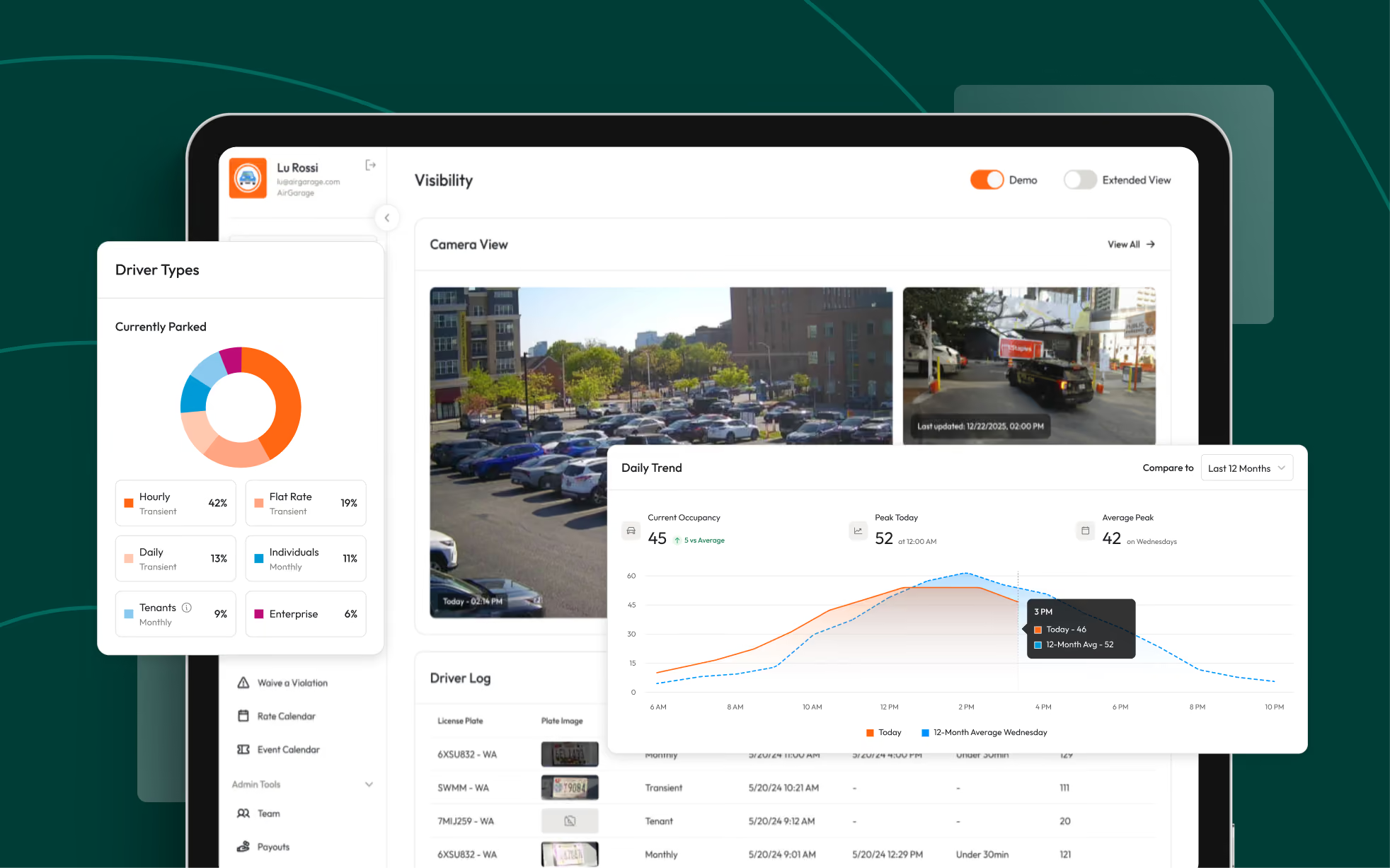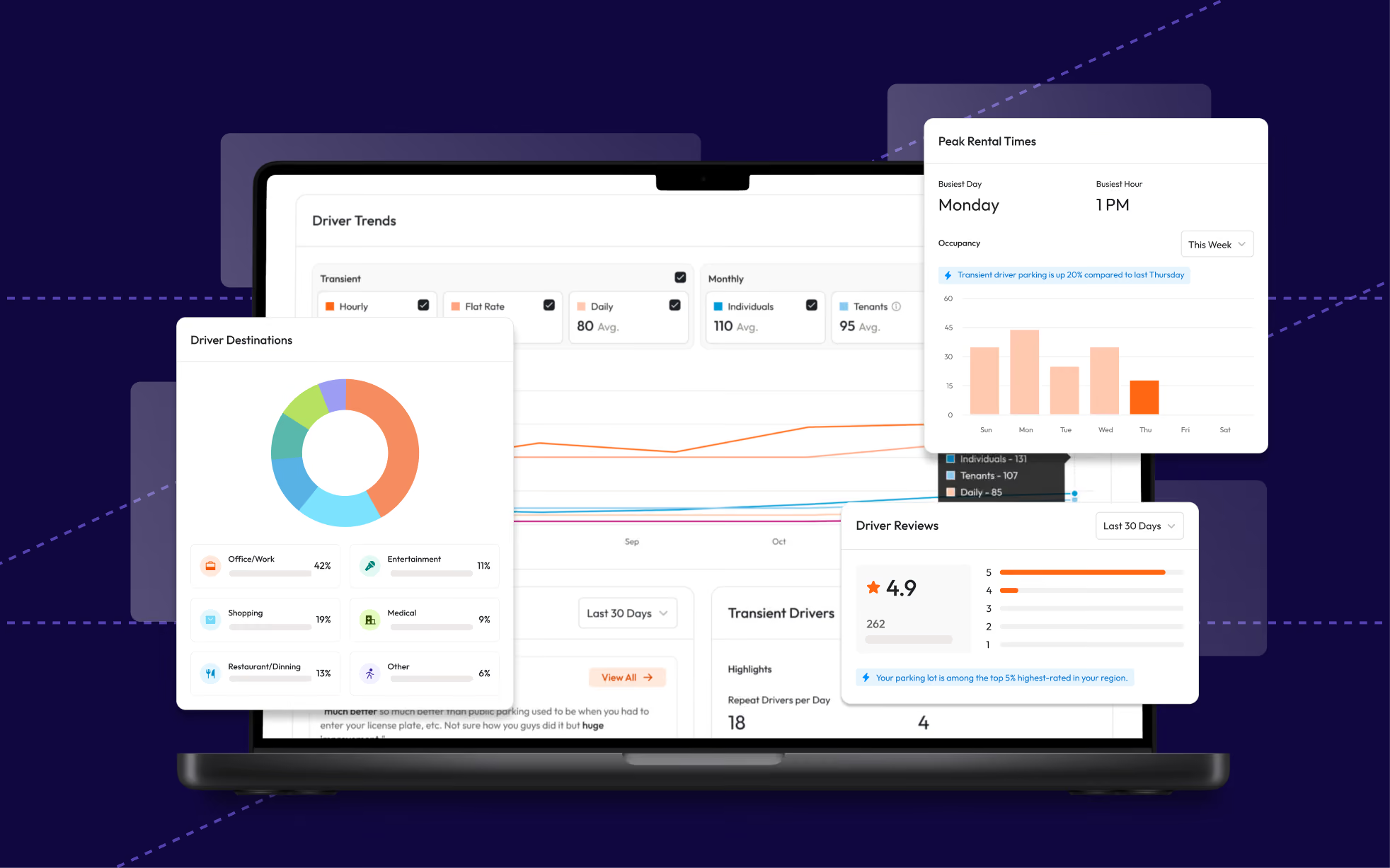


The promise of gateless parking is simple: drivers move freely, and parking works quietly in the background, capturing every entry and exit as they happen.
Gateless parking depends on reliable vehicle identification. For years, that has meant relying on license plates as the single source of truth. But in real-world parking operations, license plate data is often incomplete, incorrect, or unavailable.
That reality is exactly why AirGarage invested early in building our own proprietary License Plate Recognition (LPR) camera system.
We needed a foundation that could accurately capture every parking session, handle high-volume traffic, and integrate directly with enforcement, payments, and pricing. That work led to the development of our in-house LPR system designed specifically for the demands of parking.
With high-quality images and precise detection already flowing through our system, license plates no longer had to be the only way vehicles were identified.
Visual Vehicle Identification builds directly on top of AirGarage’s LPR foundation. Instead of solely relying on license plates, vehicles can now be identified using visual attributes like color, make, model, body type, and distinctive features, combined with real-world context such as location and time.
This added layer improves vehicle matching accuracy to 99%, enables faster issue resolution for tenants and on-site teams, and reduces friction for drivers who need help starting or validating a parking session.
It’s not a separate system or workflow. It’s an expansion of what AirGarage’s LPR infrastructure already makes possible.
To understand why Visual Vehicle Identification works, and why it’s only possible because of how AirGarage built our camera system from the ground up, we have to start at the beginning.
First we tried 3rd-party LPR. And that didn’t work.
At first, we thought the launch of LPR would be cause for celebration. The vision was simple but powerful: drivers would pull in and out of parking facilities without stopping to pay, and lot owners would capture every session and maximize their revenue.
But problems began to show within the first few weeks:
- Cars were detected multiple times during single parking sessions, creating duplicate charges
- Other vehicles weren't detected at all, allowing drivers to park for free while lot owners lost revenue
- Processing delays meant detection errors went unnoticed for hours, sometimes days. The camera equipment itself had narrow fields of vision, sometimes missing drivers entirely or capturing only partial plate information
- Slow frame rates produced blurry, low-quality images that the recognition software couldn't decipher
We wanted to automatically start and end sessions without requiring customers to stop and pay, but that's only possible if we can capture every single entrance and exit event reliably. Despite how LPR solutions were marketed and "sold into the parking industry…that wasn't really what they were optimized for," recalls Josiah Lapolla, our Director of Engineering.
Every missed session was money lost for our clients, and for us. Every technical failure also eroded trust with partners who expected reliable operations.
The existing solutions came with another bitter pill: inflated costs. Leading vendors were charging up to $5,000 per year (or more) for cameras that delivered capture rates between 70% and 80%.
This showed us a critical gap in the market. On one side are unreliable systems poorly adapted to parking applications, and on the other are commercial-grade cameras designed for high-speed freeway detection, requiring tens of thousands of dollars in upfront investment.
To offer truly reliable LPR, we'd have to build it ourselves.
Reshaping our product roadmap, and our future.
We quickly made the decision to prototype an in-house solution. The decision wasn't made lightly. Building in-house hardware was a little outside our wheelhouse, but it did fit with our plan to explore avenues for vertical integration.
The team landed on an innovative blend of infrared beams and in-lane detection to pinpoint a vehicle's exact location and speed. This data would capture an image at precisely the right moment for the clearest possible image.
Our hypothesis was straightforward: improving the sensors, cameras, and housing design would result in dramatically more accurate session detection.
To test the hypothesis, we quickly made a lightweight prototype with 3D-printed components and sensors ordered online. In January 2023, just one month after starting development, we loaded a van and drove to Charleston, SC for an on-site test with the prototype at a real customer facility.
The results exceeded our expectations, and development accelerated quickly.
Test, learn, launch.
We used an agile approach throughout development, quickly refining the v1 prototype through customer conversations, real-world tests, and rapid learning cycles. Just three months after the Charleston prototype test, we completed our first full installation at a live customer facility.
We maintained a rapid release cycle, and each new deployment provided fresh learnings that informed the next version. Customer feedback drove feature development, and the product improved quickly.
By late 2024, the team was ready to scale production in preparation for a wider release.
Today, this proprietary LPR has evolved into a competitive advantage for AirGarage properties across the country.
A foundation designed to evolve.
Building our own LPR system began as a solution to a very real problem: unreliable license plate recognition was costing parking operators revenue and creating operational risk. It has allowed us to solve those foundational challenges and create a level of accuracy, integration, and reliability that gateless parking depends on.
But just as importantly, it created a platform we could continue to build on.
Because AirGarage owns and operates the full camera and software stack, improvements don’t stop at license plates. The same high-quality images, precise detection, and real-time data that our cameras power now enable new capabilities like Visual Vehicle Identification, expanding how vehicles can be identified when plate data is missing or imperfect.
This is how AirGarage approaches innovation. Instead of static systems that require periodic overhauls, we build infrastructure that gets better over time. New capabilities are layered onto the existing foundation and delivered automatically, strengthening performance without changing how properties operate day to day.
For owners and on-site teams, that means the system you deploy today is not fixed in time. It continues to evolve, becoming more accurate, more flexible, and more resilient as AirGarage learns from real-world usage across hundreds of properties.
Visual Vehicle Identification is one example of what that approach makes possible, and a glimpse into how AirGarage will continue advancing gateless parking as conditions and expectations change.
Discover Asset Intelligence
Connect with one of our parking experts to learn more about how AirGarage proactively drives revenue, eliminates operational burden, and gives owners real-time visibility into their asset's performance.