

Camera-based parking systems use overhead cameras and License Plate Recognition software to track vehicles, eliminating gates and tickets while providing real-time occupancy data. Modern systems achieve over 99% accuracy and typically deliver 20-30% revenue increases through improved billing accuracy and dynamic pricing.
• Camera-based systems replace physical barriers with LPR technology that processes plate images in milliseconds, enabling friction-free entry and exit
• Installation costs range from $330-$600 per space for LPR cameras versus $470,000 over 10 years for traditional gated systems
• Properties switching to gateless camera systems report 20-35% revenue increases and 20-25% operating cost reductions
• Modern systems achieve 95% accuracy in daylight and 90% in low-light conditions, with single-space camera accuracy exceeding 99.5%
• Edge computing reduces latency to 195-400ms, enabling real-time processing without cloud delays
• Dynamic pricing capabilities can increase weekly revenue by an additional 15% when paired with occupancy analytics
A camera-based parking system replaces gates and tickets with cameras and License Plate Recognition software, unlocking real-time data and higher margins for owners.
If you own or manage a parking asset, you're probably used to waiting. Waiting for gate repairs, waiting for accurate revenue reports, waiting for drivers stuck at malfunctioning pay stations. Camera-based parking systems eliminate that friction by swapping mechanical hardware for software and optics.
This guide explains exactly how the technology works, what it costs, and how quickly you can expect a return on your investment.
A camera-based parking system uses overhead cameras at entry, exit, and strategic interior points to monitor vehicle movements. License Plate Recognition (LPR) software converts plate images into data in milliseconds, logging when a vehicle enters, parks, and leaves. Because no gates or tickets are required, drivers glide through while owners gain real-time occupancy data for billing and enforcement.
Urban parking management is a growing challenge with increasing vehicle numbers and limited parking space. Traditional methods often fail during peak hours, leading to inefficiencies, unauthorized usage, and revenue losses. That pressure is accelerating adoption of camera-based systems across retail centers, hotels, apartment complexes, and mixed-use properties.
Modern Automated Parking Guidance Systems rely on advanced sensor technology such as still or video camera images. The higher accuracy of these camera-based systems is a significant benefit compared to more traditional sensor technologies like loops or infrared sensors.
Key takeaway: Camera-based parking replaces physical barriers with software, giving operators real-time visibility and drivers a seamless experience.
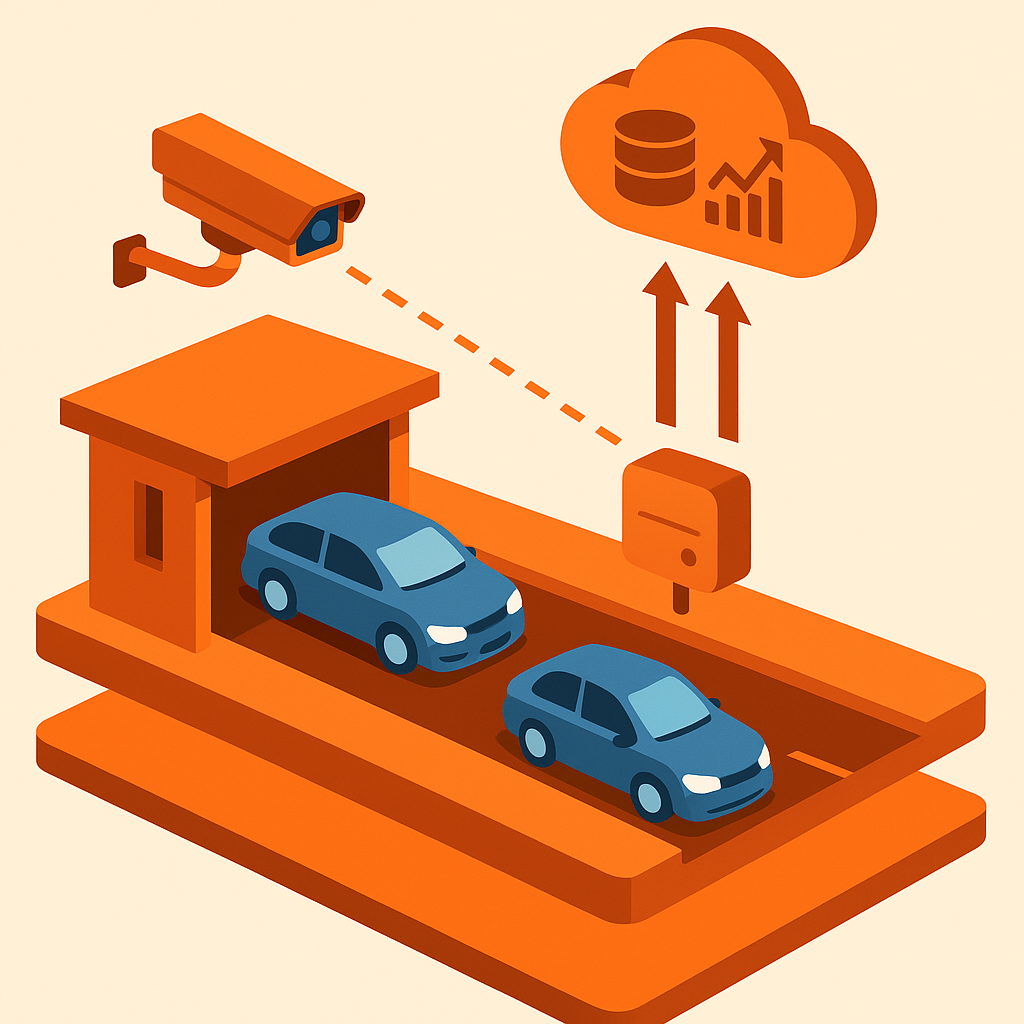
Camera-based systems consist of three core layers:
LPR systems usually include a camera, software, and a database of previously stored hot lists or previously read license plates. The proposed system architecture integrates vehicle detection, coordinate-linked IR sensors for parking slot verification, and Tesseract OCR for accurate license plate reading, aiming to achieve more reliable vehicle monitoring and fare estimation.
The system combines edge computing technology with the latest object recognition algorithms to overcome the limitations of traditional centralized systems, providing a more efficient and scalable parking management solution.
Edge computing pushes inference to on-site hardware rather than routing every frame to the cloud. When deployed on an AI-BOX edge platform, a proposed system achieves end-to-end latency p50/p95 of 195 ms and 400 ms, respectively, while sustaining 10 FPS at 3.35 W during continuous 24-hour operation.
This approach means decisions happen locally, so a driver entering your garage doesn't wait for a round-trip to a distant server.
Accuracy level in LPR refers to the percentage of correctly recognized license plates out of the total number captured. High accuracy is essential to ensure the lowest levels of errors and false readings, which could lead to incorrect information, customer complaints, higher operational costs, and potential legal issues.
Optical character recognition converts the plate image into billable data. Modern deep-learning models handle varied fonts, angles, and lighting conditions far better than earlier rule-based algorithms.
Removing gates and tickets unlocks several operational and financial benefits:
The higher accuracy of camera-based systems is a significant benefit compared to more traditional sensor technologies.
Commercial areas using smart parking have reported an increase of 20% in new customers alongside growth in revenue from paid parking. Tower Investments, owner of an 800-space garage in Philadelphia, saw "Revenue grew 20% month over month" after switching to a gateless, camera-powered system.
Billing accuracy determines whether drivers pay or dispute. A properly installed and calibrated in-motion camera-based APGS should achieve accuracy greater than 99% over a large sample size of counted vehicles during a typical day, including peak traffic periods.
Single-space camera systems can reach accuracy greater than 99.5% and should remain stable over an extended period with no accrual of errors. EnSight Technologies advertises an unmatched accuracy guarantee of greater than 99% for its camera-based car-counting solution.
These benchmarks translate directly into fewer disputed invoices and stronger collection rates.
Drivers value speed and simplicity. At Tower Investments' Parkadelphia garage, "Congestion at exits disappeared" once gates were removed. A 2025 user-experience study found that 80% of US drivers would be frustrated if in-car payments were available nearby and their car failed to inform them.
Friction-free entry and exit also reduce peak-hour queuing, which keeps adjacent streets clear and neighbors happy.
Costs vary by technology tier and lot size. Here's a general breakdown:
| Cost Category | Range |
|---|---|
| Entry-level lane counters | ~$20,000 per lane |
| Single-space ultrasonic sensors | $300-$500 per space |
| Camera-based LPR per space | $330-$600 per space |
| Advanced parking management systems | $250-$800 per space |
A gated PARCS system at a single-entrance facility can cost $470,000 over a 10-year lifespan when you factor in equipment, service calls, maintenance, software upgrades, paper tickets, and labor. Add staffing and you're looking at an additional $40,000 per shift.
Dynamic pricing adds another lever. Research shows a bid-price-based dynamic pricing methodology can increase weekly revenue by 15%. When combined with lower hardware and maintenance expenses, payback often lands in the 24- to 36-month window.
Gated systems require more equipment, more complexity, and more maintenance. Gated parking systems are more expensive because terminals, barriers, pay stations, and servers all need upkeep. On average, a parking system of any kind will last for eight to ten years, with maintenance and repair costs rising as the equipment ages.
Cameras and cloud software flip the cost structure. Hardware footprint shrinks, while analytics subscriptions deliver occupancy heatmaps, revenue forecasting, and automated alerts. The data itself becomes a revenue driver when you pair it with dynamic pricing.

Choosing the right technology depends on your property type, budget, and operational goals.
| Factor | Cameras | IoT Sensors | Gated PARCS |
|---|---|---|---|
| Accuracy | >99% | >99% | Varies with gate speed |
| Infrastructure | Power + broadband | Minimal | Heavy |
| Maintenance | Low | Low | High |
| Revenue capture | Enforcement-dependent | Enforcement-dependent | ~100% |
| Driver experience | Friction-free | Friction-free | Tickets and queues |
Cameras seem like an obvious solution—they're already installed in many parking areas and can monitor multiple spaces simultaneously. Improper installation or calibration of cameras or count zones remains the primary source of inaccuracies.
Gated systems capture 100% of revenue by design, but ungated facilities can close the gap with robust enforcement. The tradeoff is upfront hardware cost versus ongoing enforcement investment.
Sensor-only platforms can struggle with high-volume, mixed-use properties. Metropolis deployed its computer vision platform at a 132-space grocery-anchored garage that accommodates over 28,000 visits each month. Traditional gated systems failed to capture all payable visits when gates malfunctioned. After switching to vision-based enforcement, the property saw a 5x NOI improvement year-over-year.
Cameras also face challenges. Light sensitivity issues from reflective white cars and high-saturation environments can blind cameras, leading to false readings. IoT sensors address these challenges through reliable detection in all lighting conditions and minimal infrastructure needs.
The best solution often combines cameras for LPR-based billing with sensors for granular space-level guidance.
Accuracy depends on environmental conditions and proper setup. LPR accuracy is impacted by an extensive list of factors, such as lighting conditions, camera angle and position, font type and size, distance between the camera and the plate, and camera quality.
National standards require systems to capture 98% of all VRMs and accurately read 95% of captured plates. Meeting these thresholds demands correct installation, routine calibration, and weather-resistant enclosures.
Privacy is equally important. Regulators require operators to conduct Data Protection Impact Assessments before deploying ANPR. You should only keep the data for the minimum period necessary and delete it once you no longer need it. Clear signage, limited retention windows, and secure cloud storage protect both drivers and operators.
Case studies show consistent double-digit gains when properties switch to camera-based, gateless systems.
Tower Investments (Parkadelphia Garage, Philadelphia)
BPG 360 (National Portfolio)
The Showboat Resort (Atlantic City)
These results align with AirGarage's broader portfolio. Parking lot owners that switch from a legacy parking management company see an average revenue increase of 23%.
Camera-based parking systems deliver a compelling combination of lower hardware costs, higher accuracy, and better driver experiences. Dynamic pricing ensures drivers are always paying the optimal rate, while enforcement decreases violator rates and recovers lost revenue. No expensive hardware or gate systems means faster deployment and lower maintenance.
AirGarage manages 300+ properties across the United States and Canada, delivering a 20-30% net operating income increase for owners. If you're ready to unlock untapped parking revenue without the headaches of gates and tickets, AirGarage's full-stack platform combines LPR cameras, dynamic pricing, automated enforcement, and real-time analytics in a single solution.
A camera-based parking system uses cameras and License Plate Recognition (LPR) software to monitor vehicle movements, eliminating the need for gates and tickets. This system provides real-time data for billing and enforcement, enhancing efficiency and reducing operational costs.
The system consists of cameras that capture license plates, software that interprets the data, and a cloud or on-premise database for storage and processing. This setup allows for real-time monitoring and management of parking spaces.
Key advantages include faster throughput, lower hardware costs, real-time analytics, and automated enforcement. These systems improve accuracy and driver satisfaction by eliminating physical barriers and providing seamless entry and exit.
Costs vary depending on the technology and lot size. Entry-level systems can cost around $20,000 per lane, while advanced systems range from $250 to $800 per space. ROI typically occurs within 24 to 36 months due to reduced maintenance and increased revenue.
AirGarage's system combines LPR cameras, dynamic pricing, and automated enforcement to increase net operating income by 20-30%. It offers a seamless, gateless experience, reducing operational costs and enhancing revenue collection.