

License plate recognition parking systems increase NOI by 20-30% through automated billing, dynamic pricing, and reduced operating costs. Properties implementing LPR technology report 90% fewer billing errors and up to 30% lower staffing costs, while capturing more revenue from the same parking inventory.
• Revenue boost: Properties achieve 20-30% NOI increases within the first year of LPR implementation
• Billing accuracy: Automated systems reduce billing errors by 90% compared to manual methods, capturing previously lost revenue
• Cost reduction: Operating expenses drop through 30% lower staffing needs and eliminated gate maintenance
• Payment compliance: Digital payment adoption increases daily transactions by 15-20% after modernization
• Market growth: Smart parking market expanding from $8.5 billion to projected $48.3 billion by 2033
• Accuracy rates: LPR cameras achieve 95% accuracy in daylight conditions and 90% in low light scenarios
Boosting parking NOI is the top priority for asset owners, and license plate recognition parking has emerged as the fastest lever to unlock untapped revenue. If you own or manage a parking asset, you already know that traditional systems leave money on the table. This guide shows you exactly how ALPR cameras, gateless enforcement, and dynamic pricing work together to grow your bottom line.
Urban parking management is a growing challenge. Vehicle numbers keep climbing while available spaces stay flat. Traditional methods often fail during peak hours, leading to inefficiencies, unauthorized usage, and revenue losses.
The numbers tell the story. The smart parking market is projected to grow from $8.5 billion in 2023 to $48.3 billion by 2033. That explosive growth signals a clear industry shift toward technology-driven solutions.
The Global Parking Management Market size was estimated at USD 4,796.8 million in 2024 and is projected to reach USD 9,261.1 million by 2030, growing at a CAGR of 12.6%. Owners who fail to modernize risk falling behind competitors who capture higher yields with smarter systems.
Parking management also helps reduce greenhouse gas emissions by cutting vehicle congestion in parking spaces. The environmental angle adds another reason for property owners to adopt smart parking technology that benefits both NOI and sustainability goals.
Key takeaway: Traditional parking operations are becoming obsolete as data-driven systems prove they can capture significantly more revenue from the same number of spaces.
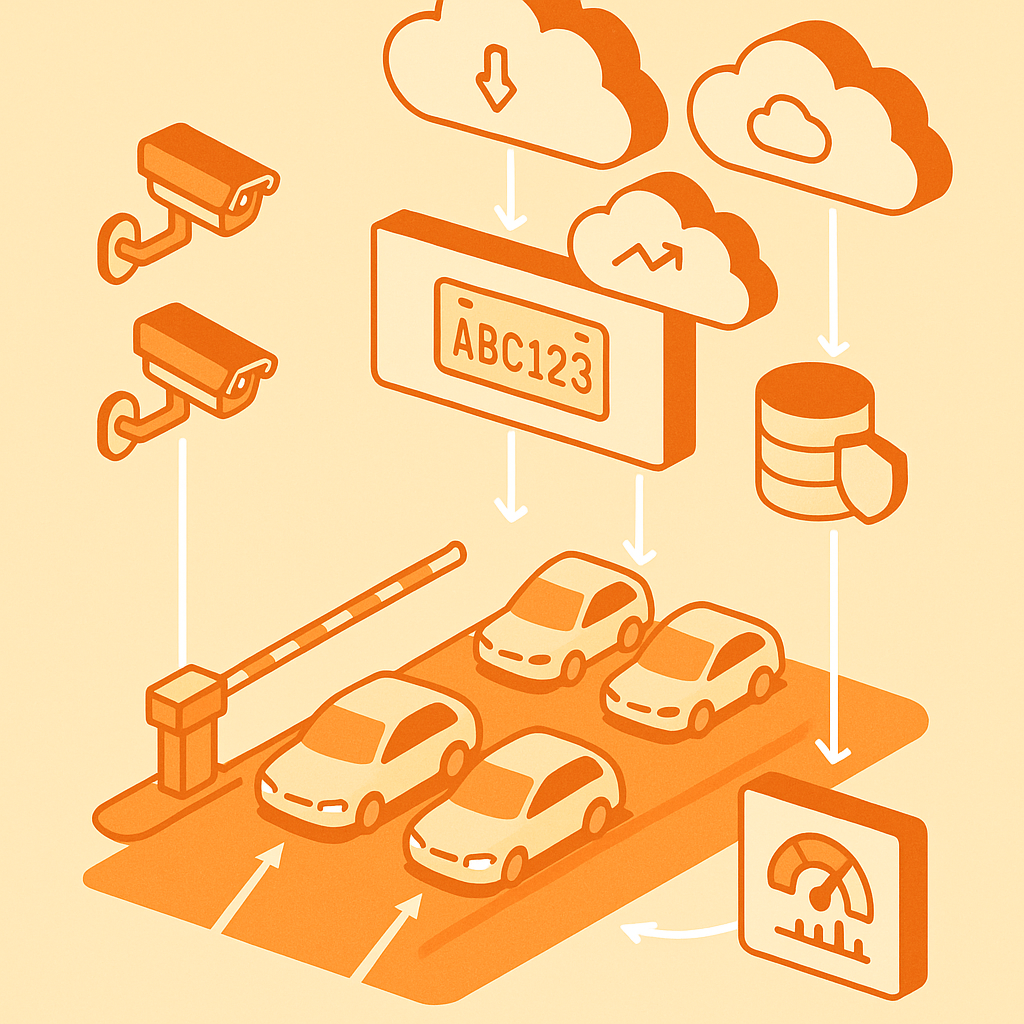
License plate recognition (LPR) technology uses cameras and optical character recognition to read license plates. LPR camera systems deployed in fixed, portable, and mobile configurations take photos of vehicles and accurately extract license plates, make/model/color data with date, time, and GPS location.
The accuracy is impressive. Testing under real-world conditions showed 95% accuracy in daylight, 90% in low light, and 93% for plates at 45-degree angles. This reliability means you can trust the data flowing into your billing and enforcement systems.
AirGarage's platform offers instant access to critical information such as parking occupancy, duration of stays, and turnover rates. This data empowers operators to make informed decisions and optimize parking availability in real time.
The technology enables parking enforcement officers to quickly enforce on-street spaces and off-street lots, discover scofflaw vehicles to collect outstanding fines, and enforce time-limited zones. Enforcement personnel can also use an iOS or Android device for mobile enforcement.
LPR technology activates four distinct revenue levers that compound to deliver significant NOI improvements.
1. Billing accuracy and capture rate
Occupancy tracking achieved less than a 5% error margin compared to manual methods, while the fare calculation module reduced billing errors by 90%. Every vehicle that enters gets logged, timestamped, and billed correctly.
2. Digital payment conversion
Businesses that modernize their payment systems often see a 15-20% increase in daily transactions after going digital. Mobile payments and contactless options remove friction that previously caused lost sales.
3. Dynamic pricing optimization
Systems automatically adjust rates based on real-time occupancy. When demand spikes, prices rise to capture maximum value. When lots are empty, competitive rates attract more drivers.
4. Enforcement and violation recovery
Smart enforcement systems using LPR integrated with parking compliance software can automatically identify non-payers and trigger citations. This closes the revenue leakage that plagues traditional operations.
As one property owner noted after switching to LPR: "Net operating income increased by 20-30%, driven by improved billing accuracy, better pricing, and more consistent enforcement." (BPG 360 Case Study)
Gateless parking systems eliminate entire cost categories that drain NOI in traditional operations. The savings stack up quickly.
| Cost Category | Traditional Gated System (5-Year) | Gateless LPR System |
|---|---|---|
| Initial Equipment | $125,000 | Included in service |
| Service Calls | $50,000 | Minimal |
| Maintenance/Parts | $100,000 | Minimal |
| Software Upgrades | $60,000 | Included |
| Paper Tickets | $10,000 | Eliminated |
| Labor | $125,000 | Reduced 30% |
| Total | $470,000 | Fraction of cost |
Source: Premium Parking Industry Analysis
Operators have reported reducing staffing costs by up to 30% after transitioning to mobile parking payments and remote parking management automation.
One industry veteran put it bluntly: "I've worked in parking for over 30 years and I have yet to see a fully automated gated PARCS system that didn't need human intervention." (Premium Parking)
Gateless systems also eliminate exit congestion. No more backed-up traffic from malfunctioning gates or slow ticket processing. Drivers flow in and out smoothly, which improves the customer experience and increases throughput capacity.
Driver satisfaction directly impacts occupancy rates and payment compliance. When parking is easy, people return. When it's frustrating, they find alternatives.
Facilities with easy-to-use payment systems report up to 30% higher satisfaction ratings from customers. That satisfaction translates into repeat visits and word-of-mouth referrals.
Consider Washington Hill, a 400-space parking lot in downtown Baltimore. After implementing modern parking technology, "customer satisfaction also saw a major lift. Improved signage, seamless entry/exit, and a fast web-based registration process helped the lot's rating climb from 2.3 stars to 4.25 stars." (Washington Hill Case Study)
Parking management helps reduce traffic congestion by minimizing vehicle mobility issues in parking spaces. Drivers spend less time circling, which improves their experience and reduces emissions.
The compliance loop is straightforward:
Drivers that park with modern systems rate the payment experience an average of 4.9 stars because of its ease of use and speed.
The proof is in the results. Here are documented outcomes from properties that made the switch to LPR-powered parking management.
The Showboat Resort, Atlantic City
The largest non-casino hotel in New Jersey faced broken gates, equipment malfunctions, and revenue leakage. After implementing gateless LPR with mobile payments and real-time reporting:
Results achieved within the first year. (Showboat Resort Case Study)
Olympus Property Group, Los Angeles
A 132-space garage serving a high-volume Sprouts grocery store accommodates over 28,000 visits monthly. Traditional systems couldn't capture all payable visits, especially when gates malfunctioned. After switching to computer vision parking:
Multifamily Properties Nationwide
According to research from Neighbor, optimizing parking pricing could boost annual NOI by over $63,000 for the average 50+ unit property in Los Angeles, or as much as $189,000 in Miami. Parking spaces are systematically underpriced in 8 of 10 major markets.
Key takeaway: These aren't theoretical projections. Real properties are achieving 20-35% revenue increases while simultaneously cutting operating costs.

Ready to explore LPR for your property? Here's a practical framework for evaluation and deployment.
Step 1: Assess your current state
Step 2: Evaluate technology options
LPR camera systems can be deployed in fixed, portable, and mobile configurations. Look for systems with:
Step 3: Address compliance requirements
Parking operations must comply with local regulations. In New York City, for example, your business must have a valid DCWP Garage or Parking Lot license. Rate signs must be posted at each public entrance, and capacity limits must be observed.
Step 4: Understand privacy frameworks
Automated License Plate Recognition technology utilizes cameras and various processes to capture and store digital images of vehicle license plates. ALPR data includes license plate number information as well as the date, time, and location when the image was collected.
Responsible operators:
Step 5: Choose a deployment model
You can purchase LPR cameras outright or as-a-service, depending on your capital preferences and operational needs. Full-service partners handle installation, maintenance, and ongoing optimization.
License plate recognition parking delivers measurable NOI improvements through four channels: better billing accuracy, digital payment conversion, dynamic pricing, and automated enforcement. The financial case is compelling.
Consider these results:
"Operational complexity was reduced. Automation and real-time reporting replaced gate maintenance, manual audits, and spreadsheet billing." (BPG 360 Case Study)
If you're managing parking assets with traditional systems, you're likely leaving significant revenue on the table. AirGarage helps property owners unlock this untapped potential with gateless LPR technology, dynamic pricing, and full-service management. Owners who switch from legacy parking management see an average 23% revenue increase.
The parking industry is transforming. The question isn't whether to modernize, but how quickly you can capture the NOI gains your competitors are already achieving.
License plate recognition (LPR) technology uses cameras and optical character recognition to read vehicle license plates, capturing data such as make, model, color, and location. This data is used for billing, enforcement, and optimizing parking operations.
LPR technology enhances parking NOI by increasing billing accuracy, enabling digital payment conversion, optimizing dynamic pricing, and improving enforcement. These factors collectively lead to significant revenue improvements and cost reductions.
Gateless LPR systems reduce operating costs by eliminating the need for physical gates, reducing maintenance and labor costs, and minimizing service calls. This leads to substantial savings compared to traditional gated systems.
LPR technology improves driver experience by offering seamless entry and exit, easy-to-use payment systems, and reducing congestion. This leads to higher customer satisfaction and repeat visits, ultimately boosting revenue.
Properties using LPR technology have reported 20-35% revenue increases and 20-25% reductions in operating costs. These improvements are due to enhanced billing accuracy, better pricing strategies, and more efficient enforcement.